Ilyas Insects
Imbrasia obscura
Imbrasia obscura
Impossible de charger la disponibilité du service de retrait
Imbrasia obscura, a large Saturniid native to tropical Africa, found across a wide range from Guinea and Nigeria through Cameroon, DRC, and Angola to Kenya and Tanzania. Documentation on captive rearing for this species is limited, general care follows the pattern of related Imbrasia species such as I. epimethea and I. jamesoni, with which the caterpillars are frequently confused.
Environment: Keep young larvae in closed plastic containers at room temperature or warmer. As larvae grow, switch to larger containers with a mesh or breathable fabric cover, or move to a netted cage for increased airflow. Provide ample flight space for adults, wingspan reaches about 10 to 11cm.
Humidity (larvae): Keep dry. Avoid wet leaves and watch for condensation inside the container. As with related Imbrasia species, excess moisture is likely poorly tolerated.
Diet (larvae): Polyphagous, recorded on Fabaceae, Euphorbiaceae, Burseraceae, Moraceae, Rhamnaceae, and Phyllanthaceae in the wild. Liquidambar and Salix are likely accepted in captivity, compared with other Imbrasia species, but this has not been specifically confirmed for I. obscura.
Appearance (larvae): Larvae are whitish with black markings, the head and spiny appendages are red with white hairs.
Behavior (larvae): Likely gregarious in early instars, consistent with most Imbrasia species, though this is not specifically confirmed for I. obscura.
Pupae care: Like other Imbrasia species, likely does not spin a cocoon and pupates in soil. Provide a layer of slightly moist, well draining substrate at least 8 to 10cm deep for wandering final instar larvae.
Humidity (pupae): Keep the substrate lightly moist, not wet, to avoid both desiccation and mould.
Emergence: No confirmed data for this species, but based on the genus, expect a long and potentially irregular pupal stage. Patience is likely required, similar to I. epimethea.
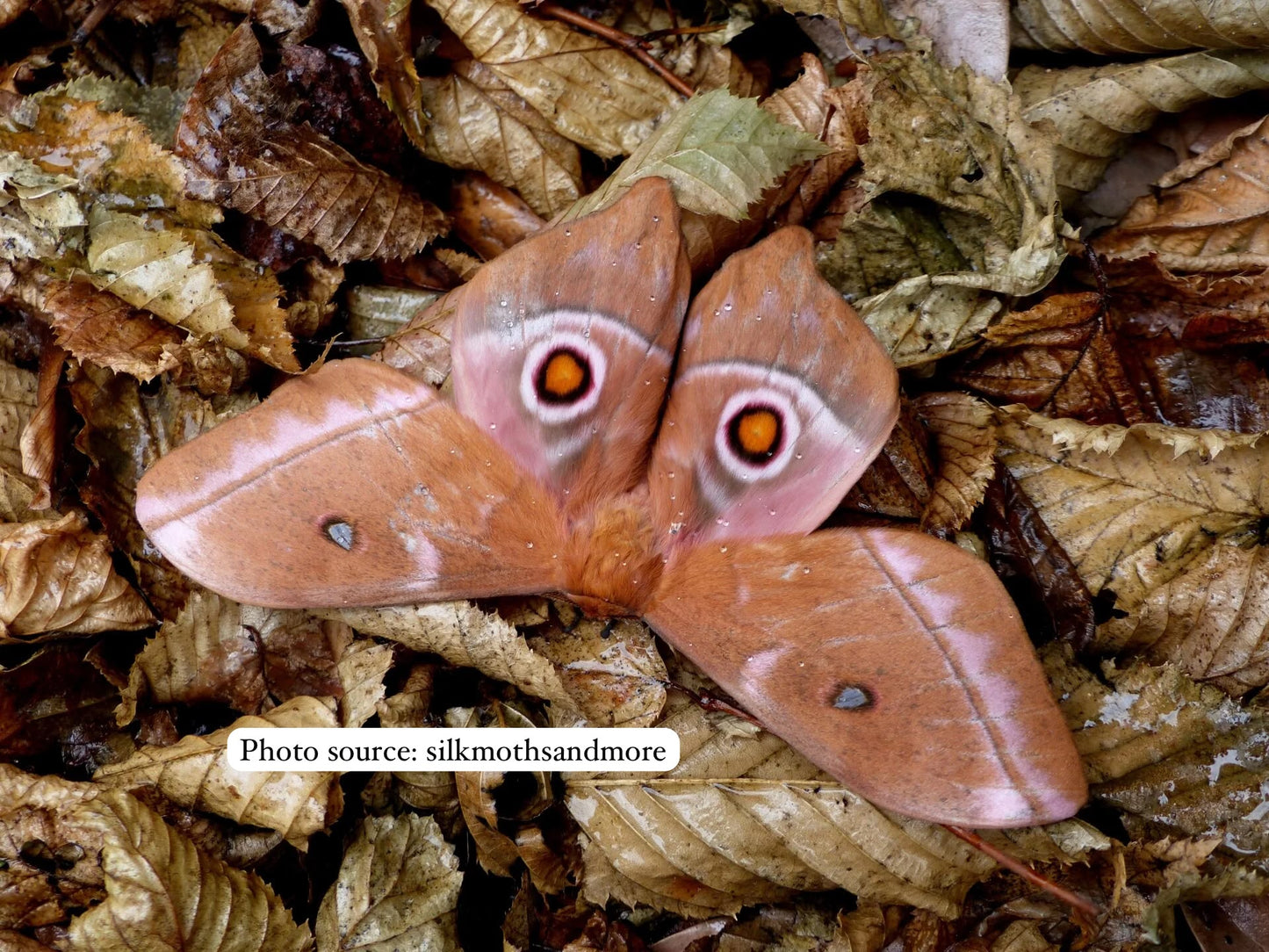
Adults: Wings are brown with two large black, red, and white eyespots on each hindwing. No functional mouthparts, adults live only to mate and reproduce.
Temperature: Room temperature or warmer throughout all life stages, consistent with its tropical origin.
Partager