Ilyas Insects
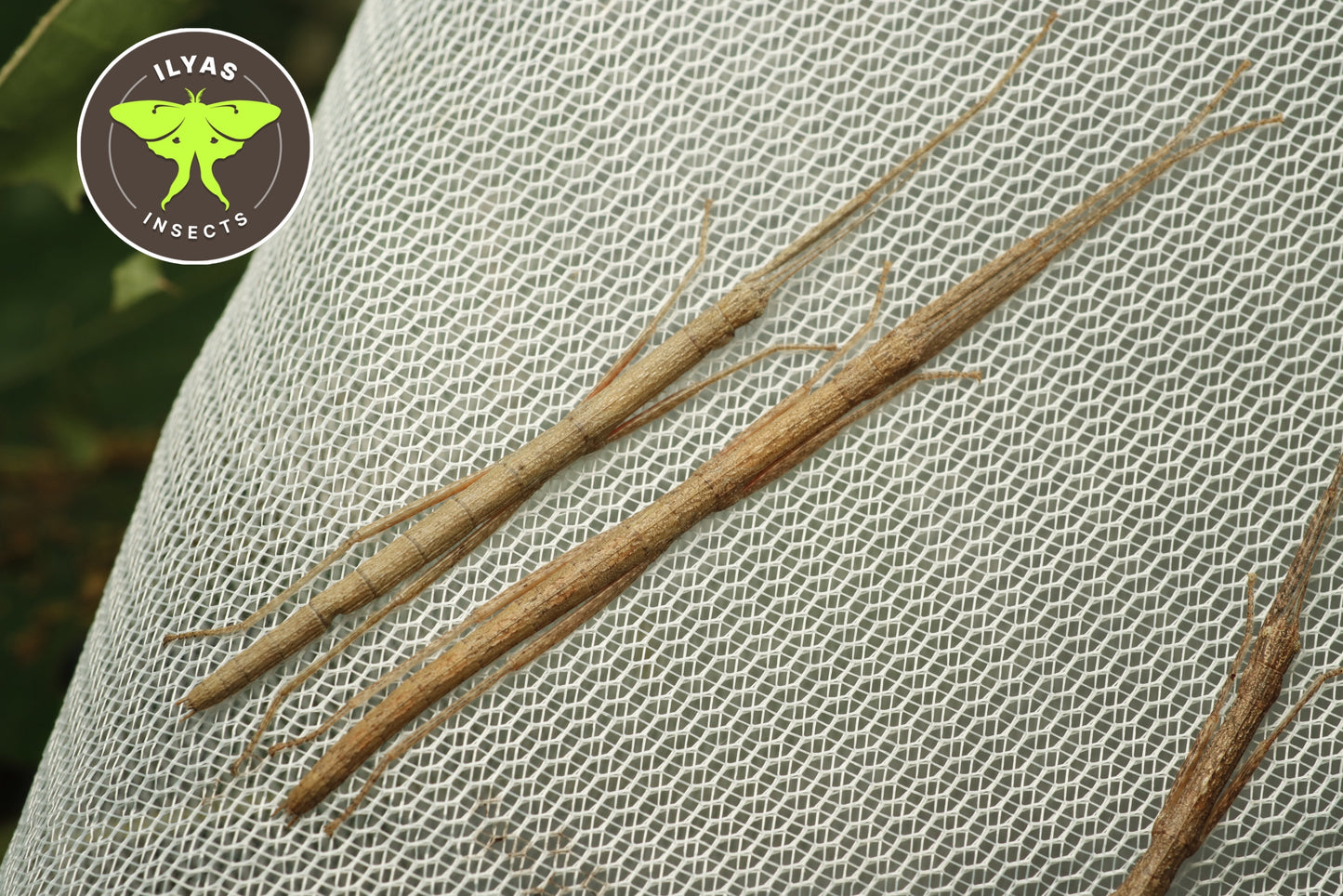
Xeroderinae sp. cf. Xenophasmina (Ratchaburi province, Thailand)
Xeroderinae sp. cf. Xenophasmina (Ratchaburi province, Thailand)
Impossible de charger la disponibilité du service de retrait
Common name: Thai Bark Stick Insect, Ratchaburi locality. This species has no established common name and is traded under its provisional identification as a Xeroderinae close to Xenophasmina.
Origin: Ratchaburi province in western Thailand, in humid forest on limestone hill country near the Tenasserim range. Like other Xeroderinae this is a bark dwelling species, spending the day pressed flat against trunks and larger branches where its outline disappears against lichen and moss.
Diet: Bramble and oak are both accepted readily and either can be used as the staple. Bramble has the advantage of being available year round, so it is the practical choice outside the oak season. Guava and salal are worth trying as alternatives but have not been confirmed for this line. Introduce any change of foodplant gradually and leave the old plant in place until the animals have moved across. Avoid garden centre plants and treated gardens entirely, as pesticide residue stays lethal long after application. Stand cut stems in a bottle with the neck plugged so nymphs cannot fall in.
Temperature: 22 to 27 degrees, with a night drop of a few degrees. Room temperature is adequate in most homes. Avoid sustained heat above 30 degrees.
Humidity: 75 to 85 percent, misted daily. This is a forest species from a consistently humid environment and it does not tolerate dry air well. At the same time the bark surfaces it sits on should be allowed to dry between mistings, so aim for humid air rather than a permanently wet enclosure. Stagnant conditions cause mould on both the foodplant and the bark decor.
Size: A small to medium species. Adult females reach roughly 5 to 7cm, strongly flattened and broad rather than stick like, mottled grey brown with darker markings that break up the outline against bark. The legs are held flat against the body at rest, with lobes and expansions along the femora that eliminate any shadow. Males are smaller and more slender at around 4 to 5cm. Nymphs show the same flattened build and cryptic colouring from hatching onwards.
Lifespan: Roughly 9 to 12 months, with adults living several months after the final moult. Expect variation until the culture is better documented.
Defense: Entirely passive and dependent on camouflage. When disturbed the animal presses itself flat and remains motionless, relying on its outline and colour to disappear. It will typically stay put rather than drop or run, which makes it easy to handle. There is no defensive spray. Legs can be shed if pulled, so coax rather than lift animals off a surface.
Breeding: Assume both sexes are required, as parthenogenesis has not been demonstrated in this line. Females begin laying several weeks after the final moult. Like other bark dwelling phasmids the eggs are laid onto or glued against a surface rather than flicked freely, so check bark pieces, corners and the underside of decor as well as the floor when collecting. Eggs are small and cryptic. Incubate on damp sand or vermiculite at around 24 to 26 degrees, kept slightly moist but never wet. Incubation is likely in the range of 3 to 6 months. Because this species is not widely established, keeping records of laying dates and hatch rates is genuinely useful for the hobby.
Housing: Vertical surface area matters more than open height for this species, since the animals live against bark rather than hanging from twigs. An enclosure of 30x30x45cm suits a small group of adults comfortably. Furnish it with several pieces of cork bark or similar slabs placed upright, as these are where the animals will spend the daytime and where females will often deposit eggs. Provide foodplant alongside the bark rather than instead of it. Keep enough clear vertical space beneath a suitable surface for safe moulting, use a substrate that holds moisture, and combine mesh with solid panels so humidity stays up without the air going stale.
Partager